

The phrase “12 Commandments” refers to an interpretive framework that combines the Decalogue’s prohibitions with Jesus Christ’s two greatest commandments to present a fuller practical guide for Christian living. This article explains what those twelve directives are, where they come from in Scripture, and how they function as moral teaching within the broader Mosaic covenant and New Testament fulfillment. Readers will gain a clear numbered presentation of the twelve commands, a concise history of their textual origin and theological interpretation, and practical guidance for applying each commandment in twenty-first-century contexts. Many Christians wrestle with counting methods—why some sources list ten while others set out a twelve-item framework—and this guide shows the mechanisms that produce those different counts and how Jesus’ summary reframes the law’s intent. The piece also connects theology to practice through short case examples, reflective prompts, and tools that support devotional formation without distracting from biblical substance. Finally, the article points to structured study pathways and supportive resources—including a devotional app that helps you build daily habits of prayer and Bible reading—that help readers move from knowledge to daily obedience and communal discipleship.
What Are the 12 Commandments in the Bible?
The twelve-commandment framework lists directives drawn from the Exodus/Deuteronomy Decalogue alongside Jesus’ two summative imperatives, producing a practical sequence for moral formation. The list below presents each commandment in concise form and one-line summaries to clarify function and emphasis. This ordered list is intended for quick reference and to serve as a starting point for deeper study of the scriptural passages that anchor each item. Each numbered commandment is phrased broadly so that readers can apply it to concrete life choices; subsequent sections unpack meaning, biblical support, and modern application. After reviewing the list, the following subsections address counting differences and scriptural authorship to clarify how a “twelve” count arises.
- No other gods: Worship the one true God and avoid idolizing anything in God’s place.
- No idols: Reject crafted images and representations that replace faithful devotion to God.
- Do not misuse God’s name: Use God’s name with reverence and integrity in speech and vow.
- Remember the Sabbath: Set apart time for rest, worship, and renewal in covenant life.
- Honor parents: Respect and care for family as a foundational social and spiritual duty.
- Do not murder: Preserve life and oppose unjust killing while promoting reconciliation.
- Do not commit adultery: Maintain sexual faithfulness and protect covenantal relationships.
- Do not steal: Respect others’ property and practice honest stewardship.
- Do not bear false witness: Speak truthfully in testimony, relationships, and public life.
- Do not covet: Regulate desires to prevent envy and destructive longing for another’s goods.
- Love God: Actively orient life toward loving God with heart, soul, and mind (Jesus’ summary).
- Love neighbor: Intentionally seek the good of others as a practical outworking of love of God.
How Do the 12 Commandments Differ from the Traditional Ten Commandments?
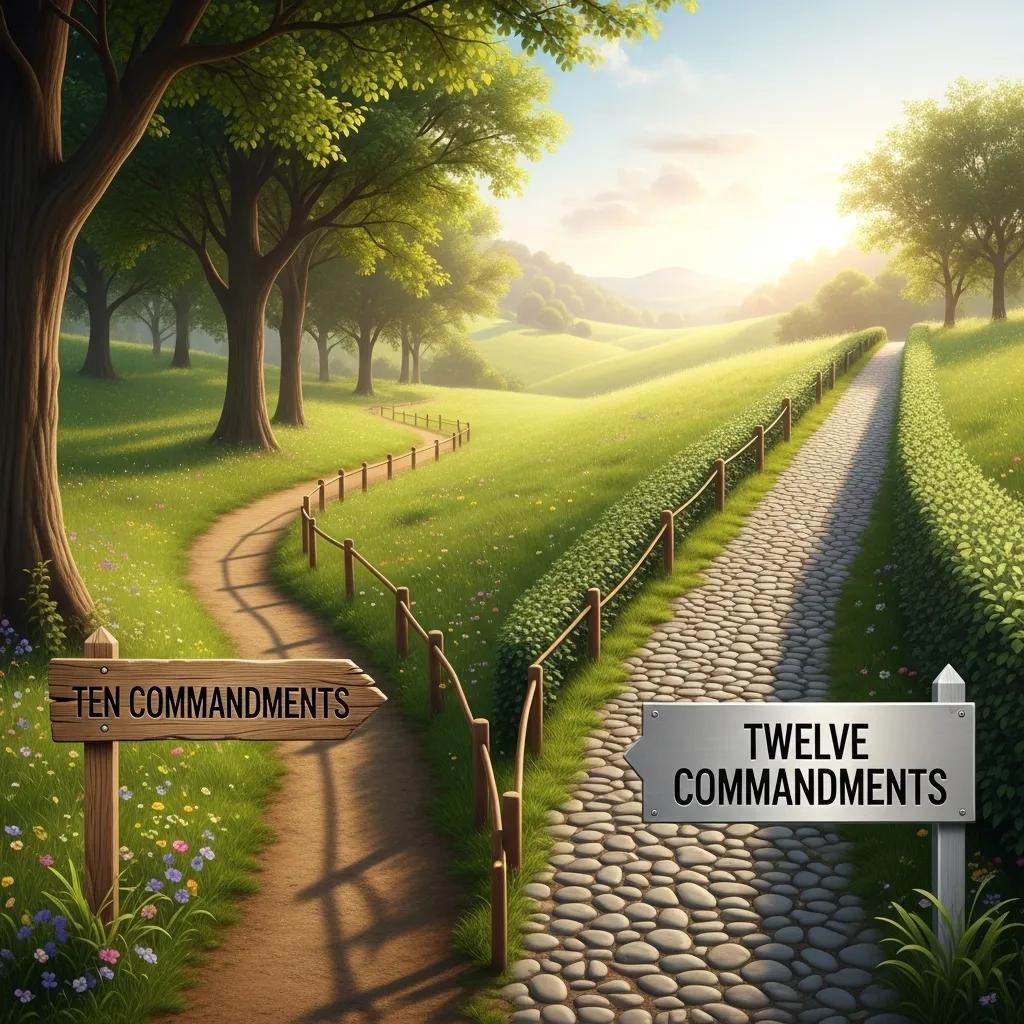
A clear way to understand the “12” formulation is to recognize that counting depends on how clauses in Exodus 20 and Deuteronomy 5 are divided and how Jesus’ summary is incorporated. Different traditions split or combine clauses—some combine prohibitions into single items while others separate them—so “ten” is a canonical count for many but not the only pedagogical arrangement. For example, some readers separate “no other gods” and “no idols” into distinct commands, and they add Jesus’ two-fold summary as discrete, emphatic items, producing twelve directives in practice. These counting choices reflect interpretive priorities: whether emphasis falls on legal form, liturgical use, catechesis, or Christological fulfillment. Understanding these differences helps readers see that numbering is secondary to discerning the moral intent behind each injunction; the core ethical content remains continuous across numbering systems. This comparison leads naturally to a closer look at scriptural authorship and the historical setting where the Decalogue was given.
Who Gave the 12 Commandments According to Scripture?
Scripture presents the Decalogue as the words of God spoken to Israel and delivered through Moses on Mount Sinai, forming a covenantal nucleus within the broader Mosaic Law. Exodus 20 and Deuteronomy 5 record the voice of God giving prohibitions and commands that structured Israel’s communal life and worship, and Moses functions as the human mediator who conveys those instructions to the people. In the New Testament, Jesus of Nazareth summarizes the law by identifying love of God and love of neighbor as the greatest commandments, thereby reframing the Decalogue’s intent around covenantal love and neighborliness. This layered authorship—God as origin, Moses as lawgiver/mediator, and Jesus as interpreter—shows how authoritative ethical content is transmitted and reinterpreted across Scripture. Recognizing these roles clarifies why some modern frameworks integrate Jesus’ summary with the Decalogue to produce a twelve-item practical guide.
What Is the Historical and Theological Origin of the 12 Commandments?
The Decalogue emerges from a specific historical moment—the Sinai covenant—where God established boundaries for Israel’s life as a distinctive covenant community, and theological reflection later interprets those boundaries for enduring moral instruction. Ancient Near Eastern covenant forms provide background for why a set of succinct, covenantal stipulations functioned as Israel’s identity markers after the Exodus, and the Decalogue anchors broader Mosaic legislation as moral core. Over time, theological traditions read Exodus and Deuteronomy with differing emphases: some stressed liturgical and sacramental contexts while others highlighted moral universals for ethical life. Theological interpretation also wrestles with the Decalogue’s typology—seeing it as a moral baseline that anticipates fuller ethical formation in Christ. These historical and theological layers explain why different Christian traditions sometimes count or present the commandments differently. The next element clarifies Mosaic Law’s relation to the Decalogue in more detail.
| Source Text | Historical Context | Theological Interpretation |
|---|---|---|
| Exodus 20 | Sinai revelation within covenant formation for Israel | Foundational moral stipulations that identify covenant identity |
| Deuteronomy 5 | Moses’ sermonic restatement before entry into the Promised Land | Liturgical reaffirmation emphasizing memory and obedience |
| New Testament (Matthew/Mark) | Jesus’ teaching in Jewish legal and prophetic context | Christ reinterprets law’s intent, emphasizing love and heart-level obedience |
How Does the Mosaic Law Relate to the 12 Commandments?
The Mosaic Law encompasses ceremonial, civil, and moral provisions while the Decalogue represents a compact moral core intended to govern covenantal life and social cohesion. The Decalogue’s prohibitions and commands operate as meronomic parts of the larger Mosaic corpus: they are integral pieces that give moral direction distinct from ritual or civil regulations. Historically, scholars and theologians have distinguished moral laws—those reflecting God’s character and universal justice—from ceremonial practices tied to temple worship or civil statutes tailored to ancient Israelite governance. The Decalogue’s moral emphasis provides a stable ethical framework that later interpreters, including Jesus, draw upon when summarizing or fulfilling the law. This relational placement leads to a hermeneutic that reads the Decalogue as enduring moral instruction while situating specific civil or ceremonial statutes in their historical context.
What Are Jesus Christ’s Two Greatest Commandments and Their Connection?
Jesus names two primary commandments: to love God with whole being and to love neighbor as oneself, summarizing the law’s direction toward relational fidelity and just conduct. Biblically, these appear in Matthew 22 and Mark 12 where Jesus cites Deuteronomy and Leviticus to show that the Decalogue’s moral demands find their telos in love—love that animates worship, moral restraint, and communal responsibility. The connection is hermeneutical: Jesus reframes specific prohibitions as protections and expressions of love, so fulfilling the law becomes actively choosing what honors God and serves neighbor. Practically, this reduces legalism to a posture of devotion and compels believers to translate commandments into positive, neighbor-oriented ethics. Seeing this link invites practical reflection on how commandments guide everyday decisions in modern life.
What Is the Meaning and Significance of Each of the 12 Commandments?
Explaining each commandment involves stating its core moral meaning, its theological significance, and practical guidance for contemporary Christians seeking faithful obedience. Each commandment functions as both a boundary and an orientation: boundaries that protect covenant life and orientation that forms character toward God and neighbor. Below is a concise EAV-style table that quickly summarizes the core meaning and a practical modern application for each commandment so readers can scan and internalize how ancient directives map to daily decisions.
| Commandment | Core Meaning | Modern Application |
|---|---|---|
| No other gods | Exclusive devotion to God | Prioritize spiritual disciplines over idolizing success or pleasure |
| No idols | Reject substitutes for God | Avoid consumer idols and status-driven worship |
| Do not misuse God’s name | Reverent speech and vows | Use truthful, respectful language in public and private life |
| Remember the Sabbath | Regular rest and worship | Set weekly rhythms for rest and communal worship |
| Honor parents | Family loyalty and care | Provide elder care and teach children spiritual values |
| Do not murder | Protect human life | Advocate for life-affirming policies and reconciliation |
| Do not commit adultery | Sexual faithfulness | Maintain fidelity and integrity in relationships |
| Do not steal | Respect for property | Practice honest business dealings and generosity |
| Do not bear false witness | Truthfulness in testimony | Resist slander and promote transparency in speech |
| Do not covet | Control of desires | Cultivate contentment and responsible stewardship |
| Love God | Wholehearted devotion | Deepen prayer, study, and worship practices |
| Love neighbor | Active care for others | Serve community needs and practice neighborly justice |
How Does Each Commandment Guide Christian Ethical Behavior?
Each commandment prescribes behaviors that cultivate virtues—loyalty, reverence, justice, fidelity, truthfulness, contentment, and charity—which together form a holistic Christian ethic. For example, “do not steal” trains honesty and respect for others’ wellbeing, while “honor parents” embeds responsibility and intergenerational care as moral practices. The commandments orient conscience and public action: they shape speech norms, economic behavior, sexual ethics, and civic responsibility in ways that reflect covenantal fidelity. Reflection prompts—such as examining what competes for central devotion or where speech undermines neighbor care—help translate abstract commands into daily spiritual disciplines. These behavioral implications show readers how the Decalogue functions not as mere rule-following but as formative practices that reshape desires and communities.
What Biblical Verses Support the Understanding of Each Commandment?
The primary scriptural anchors are Exodus 20 and Deuteronomy 5 for the Decalogue, with New Testament cross-references that reinterpret and apply the laws’ intent for Christian discipleship. For instance, Exodus 20:3-17 and Deuteronomy 5:7-21 present the core prohibitions, while Matthew 22:37-40 and Mark 12:29-31 record Jesus’ summary emphasizing love of God and neighbor. Additional New Testament passages—such as Romans 13:8-10 and James 2:8—echo the Decalogue’s moral thrust and show practical application in Christian communities. These textual linkages demonstrate scriptural continuity and hermeneutical movement from command to fulfilled ethic in Christ. Readers seeking deeper verse-by-verse study can use these citations as entry points for devotional reflection and small-group study.
How Can Christians Apply the 12 Commandments in Modern Life?

Translating ancient commands into contemporary practice requires intentional habits that form character, communal accountability that shapes behavior, and spiritual disciplines that orient desire toward God and neighbor. The practical examples below show concrete behaviors and small spiritual practices that embody each commandment in family, work, digital life, and public engagement. These applications emphasize manageable, repeatable actions—like daily prayer, weekly rest, truthfulness in online communication, and sacrificial generosity—that reinforce obedience over time. After these examples, the section maps each commandment to Faithtime.ai features that can support disciplined growth by offering devotion tracking, guided study, and conversational Bible help.
Everyday practices that embody the commandments include:
- Sabbath rhythms: Schedule a regular period for rest and worship that protects family time and spiritual refreshment.
- Speech discipline: Practice brief daily examinations of speech to reduce gossip and false witness online and offline.
- Neighborly service: Adopt monthly habits of service—volunteering, visiting, giving—that concretely love those in need.
The following EAV-style table maps each commandment to a recommended daily practice and a corresponding Faithtime feature to help sustain the practice. This mapping is intentionally practical and proportionally integrated so the tool supports, rather than replaces, spiritual formation.
| Commandment | Daily Practice | FaithTime Feature |
|---|---|---|
| Remember the Sabbath | Schedule a Sabbath block for worship and rest | Devotion tracking and weekly devotionals |
| Love neighbor | Daily acts of kindness or short prayers for others | Guided prayer prompts and community check-ins |
| Love God | Morning prayer and scripture reading | Daily devotionals and Bible Lessons |
| Do not bear false witness | Pause before sharing news; verify sources | Bible chat for ethical reflection and study |
What Are Examples of Living Out the Commandments Today?
Practical, modern scenarios make the commandments vivid and actionable across common life settings: workplace integrity, social media conduct, family obligations, and civic responsibility. For instance, “do not bear false witness” can mean verifying facts before reposting on social platforms and apologizing when wrong; “honor parents” may involve arranging care plans and regular phone calls; “do not covet” translates into budgeting and gratitude practices that counter comparison culture. In workplaces, “do not steal” and “do not commit adultery” translate into ethical transactions and respect for boundaries; in neighborhoods, “love neighbor” can be concrete acts such as helping with groceries or participating in community projects. These short cases demonstrate that commandments shape both private virtues and public actions, guiding Christians to faithful presence in diverse social spheres.
How Does FaithTime Support Spiritual Growth Through the 12 Commandments?
Faithtime.ai (branded also as FaithTime and presenting the FaithTime App) offers several features designed to help users translate moral teaching into daily habits—devotion tracking, daily devotionals, guided prayer prompts, Bible study tools, an AI-powered Bible Chat, and a “Bible Lessons” section that includes topic-focused lessons. These app resources map naturally to commandment-focused disciplines: devotion tracking reinforces Sabbath and prayer rhythms, guided prayer prompts cultivate love for neighbor through intentional intercession, and Bible Chat helps clarify difficult passages that shape understanding of prohibitions and obligations. For example, a short seven-day devotion series on “honoring parents” could combine scripture readings, reflection questions, and a tracking habit to encourage sustained practice. These feature descriptions are offered as supportive tools for disciplined formation, emphasizing user benefit: regular prompts, short lessons, and conversational help that encourage small, sustainable changes aligned with the commandments; to see how each tool can serve your spiritual routines in more detail, you can explore FaithTime features and choose the ones that best fit your daily practice.
This practical integration shows how technology can scaffold spiritual practices without replacing the work of community, teaching, and personal repentance; using such tools can help convert knowledge of the commandments into embodied daily obedience.
If you have further questions about applying these principles or need personalized guidance, the FaithTime team is available to assist. You can easily reach out to us for support and inquiries.
What Are Common Questions About the 12 Commandments?
Readers commonly ask whether the “12 Commandments” are biblically accurate and how different traditions interpret numbering and emphasis. Short, direct answers followed by concise elaboration help clarify common confusions and guide further study. The FAQ-style responses below are crafted for clarity: one-sentence answers to capture the core point, then one-to-two sentences of brief explanation and reference. These answers aim to equip readers for further reading and practical application while remaining theologically balanced.
Are the 12 Commandments Biblically Accurate and Recognized?
Yes; the ethical content represented by a twelve-item framework is drawn from biblical texts, though the specific count reflects an interpretive arrangement rather than a different canonical text. Exodus 20 and Deuteronomy 5 supply the Decalogue’s prohibitions, while Jesus’ statements in Matthew 22/Mark 12 supply the two greatest commandments that many add as distinct, emphatic directives. Consequently, the “12” presentation is a pedagogical way to combine Decalogue content with Jesus’ summary for catechesis and practical formation. Readers should note that accuracy refers to content alignment with Scripture; numbering is a secondary organizational choice meant to aid comprehension and application.
How Do Different Christian Traditions Interpret the Commandments?
Christian traditions vary whether they divide or combine clauses and whether they emphasize sacramental, liturgical, or purely moral readings; typical differences include how the first two commands (about gods and images) are counted and whether Jesus’ summary is treated as separate commands. For example, some traditions maintain a classic “Ten Commandments” division rooted in patristic or confessional formulations, while others present a twelve-point practical guide that adds Jesus’ twofold summary to the Decalogue. These differences reflect hermeneutical preferences and pastoral priorities rather than contradictions in moral content. For readers seeking deeper denominational perspectives, comparing Exodus, Deuteronomy, and New Testament summaries offers a helpful pathway for respectful, informed study.
- Counting variance: Different traditions split and combine clauses in distinctive ways.
- Theological emphasis: Some prioritize liturgical memory, others moral universals or Christological fulfillment.
- Pastoral impact: Numbering choices shape catechesis and family instruction strategies.
These short points highlight the main axes of difference and point readers back to scriptural texts for direct engagement.
Are There Practical Next Steps for Studying the Commandments?
Yes; disciplined study paired with small, repeatable practices produces the best results for internalizing the commandments—combine reading Exodus/Deuteronomy passages with Jesus’ gospel summaries, use reflection prompts, and adopt one small habit per week to practice.
- Read the key texts: Exodus 20, Deuteronomy 5, Matthew 22.
- Practice a focused habit: One commandment per week with an action step.
- Reflect and adjust: Use journals or small groups to track progress and accountability.
This article has presented the twelve-commandment framework, explored its scriptural origins, unpacked meaning for each command, shown practical modern applications, and identified supportive tools for disciplined practice. The structure is designed to help readers both understand and live the commandments in ways that form devotion to God and faithful service to neighbor. Discover commandment-focused Bible lessons, prayers for obedience, devotions on the Ten Commandments, related Bible verses, all from the FaithTime homepage.
If understanding the commandments has stirred a desire to read more of Scripture systematically, you might find it helpful to follow a guide like best order to read the Bible, which outlines a thoughtful sequence for engaging both Old and New Testament books. Since the Decalogue is closely tied to Moses’ role as covenant mediator, you can also dive deeper into his story with did Moses go to heaven, which reflects on his life, death, and enduring significance in salvation history.