Prayer for Christmas is a focused form of Christian prayer that remembers the birth of Jesus Christ, expresses worship, and brings practical spiritual benefits such as gratitude, petition, and intercession. This guide explains what Christmas prayer is, why it matters, and gives ready-to-use prayers, family routines, traditional Catholic devotions, and scripture reflections to help you pray through Advent and the Christmas season. Many people feel rushed or distracted during the holidays; targeted short Christmas prayers and simple family rituals help center attention on the Nativity, cultivate peace and joy, and connect daily life to faith. The article outlines theological grounding, gives quick prayers for busy schedules, offers a step-by-step family prayer structure, surveys Catholic novenas and liturgical texts, describes how the Faithtime.ai devotional features can support your practice, and curates Bible verses for reflection. Read on for practical examples, short prayers, and structured templates so you can pray with purpose at Christmas and carry the season’s themes of hope, peace, and joy into everyday life.
Why Is Prayer Important During Christmas?
Christmas prayer is important because it intentionally reorients our hearts to the incarnation, providing spiritual focus amid seasonal busyness and creating space for worship, gratitude, and compassion. Prayer works by recalling the Nativity narrative, fostering an inward posture of thanksgiving, and directing attention to others in need, which produces measurable emotional benefits like reduced anxiety and increased belonging. In practical terms, Christmas prayer functions as a religious observance and a daily devotion that strengthens relationships and invites reconciliation during family gatherings. The following brief list highlights core benefits so you can quickly see why prayer matters at Christmas.
Christmas prayer delivers three central benefits:
- Centers Worship: Prayer refocuses celebrations toward Jesus Christ and worship rather than consumer activity.
- Cultivates Peace: Short prayers and breath-based invocations reduce stress and foster calm presence.
- Extends Compassion: Intentional intercession broadens holiday concern to neighbors, refugees, and the vulnerable.
These benefits lead naturally into how prayer connects us to the story of Jesus and why themes like peace, joy, and hope are the spiritual fruit of Christmas prayer.
How Does Christmas Prayer Connect Us to Jesus Christ and God?
Christmas prayer connects believers to Jesus Christ and God by recalling the Nativity narratives—especially the shepherds, angels, and manger scenes—and by translating those stories into worship, thanksgiving, and active love. Scriptural anchors such as Luke 2 provide the textual basis for remembering incarnation themes, and devotional reading of these passages prompts praise and wonder that orient the heart toward God. Practically, praying Luke 2 or a short natal reflection creates a bridge between historical event and present worship, inviting believers to respond with gratitude and obedience. A simple example prayer captures this link: “Lord Jesus, born among us, kindle wonder in our hearts and help us share your peace with our neighbors,” which moves from memory to petition and then to mission, preparing readers to pray for specific needs around the table.
What Are the Benefits of Praying for Peace, Joy, and Hope at Christmas?
Praying for peace, joy, and hope at Christmas brings immediate emotional relief and longer-term spiritual resilience by aligning prayers with the core theological themes of the season. Peace-centered petitions calm anxiety and promote reconciliation in strained family relationships, while prayers for joy encourage gratitude and celebration even amid hardship. Hope-focused prayers reframe difficulties by pointing to God’s promises and the forward-looking expectancy that characterizes Advent devotionals.
For practical application, a one-line breath prayer—“Spirit of God, grant us peace”—can be used during stressful transitions to restore calm and focus. These experiential benefits prepare the heart to offer welcome and generosity, which naturally connects to family prayer practices and communal devotions described next.
What Are the Best Short Christmas Prayers for Busy Schedules?

Short Christmas prayers are compact invocations or blessings designed for people with limited time, offering concentrated worship, gratitude, or petition in one to three lines. These micro-prayers work because they pair a clear intention with a simple phrase that can be repeated, creating a devotional habit that fits into commutes, meals, or brief pauses. Use short Christmas prayers to anchor your day—before a meal, during a commute, or at night—so the season’s themes of joy and hope become regular touchpoints rather than occasional sentiments.
Use these short prayers for everyday holiday moments:
- Before a Meal (Dinner Blessing): “Blessed Savior, thank you for this food and for the gift of your presence.”
- On the Go (Commute or Errand): “Jesus, be with me now; let your peace guide my steps.”
- Before Bed (Night Prayer): “Gracious God, thank you for this day; keep hope strong in our hearts.”
- Quick Gratitude (One-line): “Thank you, Lord, for the gift of your love.”
These concise prayers can be personalized by inserting names or needs—“thank you, Lord, for [name]”—and work well as habitual micro-devotions that preserve focus throughout the day. Below is a quick reference table to help busy readers pick a prayer by context and length.
Intro: The table below lists short prayers, their approximate length, and best use-cases so you can quickly match a prayer to a moment in your holiday routine.
| Prayer | Length (approx.) | Best use-case |
|---|---|---|
| Dinner Blessing: “Blessed Savior…” | 1 line | Christmas dinner, family meals |
| Journey Prayer: “Jesus, be with me now…” | 1 line | Commute, errand, travel |
| Night Prayer: “Gracious God…” | 1 line | Bedtime reflection |
| Gratitude Line: “Thank you, Lord…” | 1 line | Quick pause, checkout line |
This quick-reference makes it easy to select a prayer that fits your schedule and intention, encouraging consistent spiritual practice even in busy seasons.
Which Quick Prayers Express Gratitude and Worship?
Short prayers focused on gratitude and worship distill praise into a single declarative sentence that opens the heart to thanksgiving and reverence. Use these lines before meals, upon waking, or when you notice a moment of beauty; they function as responsive prayer lines that can be spoken aloud or silently. Examples include: “We praise you, God, for your gift of Jesus,” and “Thank you for this family and the love we share,” each easily personalized with specific names or needs. For family use, consider a responsive structure where an adult leads and children repeat a short line to make worship accessible and memorable. These quick gratitude prayers encourage habitual thanksgiving and segue naturally into family devotions and longer moments of reflection.
How Can Short Prayers Fit into a Holiday Routine?
Short prayers fit into a holiday routine by associating a brief invocation with a habitual trigger—coffee, a doorway, switching off a light, or setting the table—so prayer becomes a micro-habit embedded in daily rhythms.
To create consistency, choose 2–3 triggers and attach a one-line prayer to each, then repeat those lines for several days to build a devotional streak. Practical tips include pairing prayers with regular actions (e.g., prayer at coffee, prayer before driving), setting soft reminders, and using short scripture verses as prompts for a 30–90 second devotion. These micro-habits support a pattern of daily devotions that sustain spiritual focus through the busy season and naturally lead into family worship structures described next.
How to Pray as a Family During Christmas?
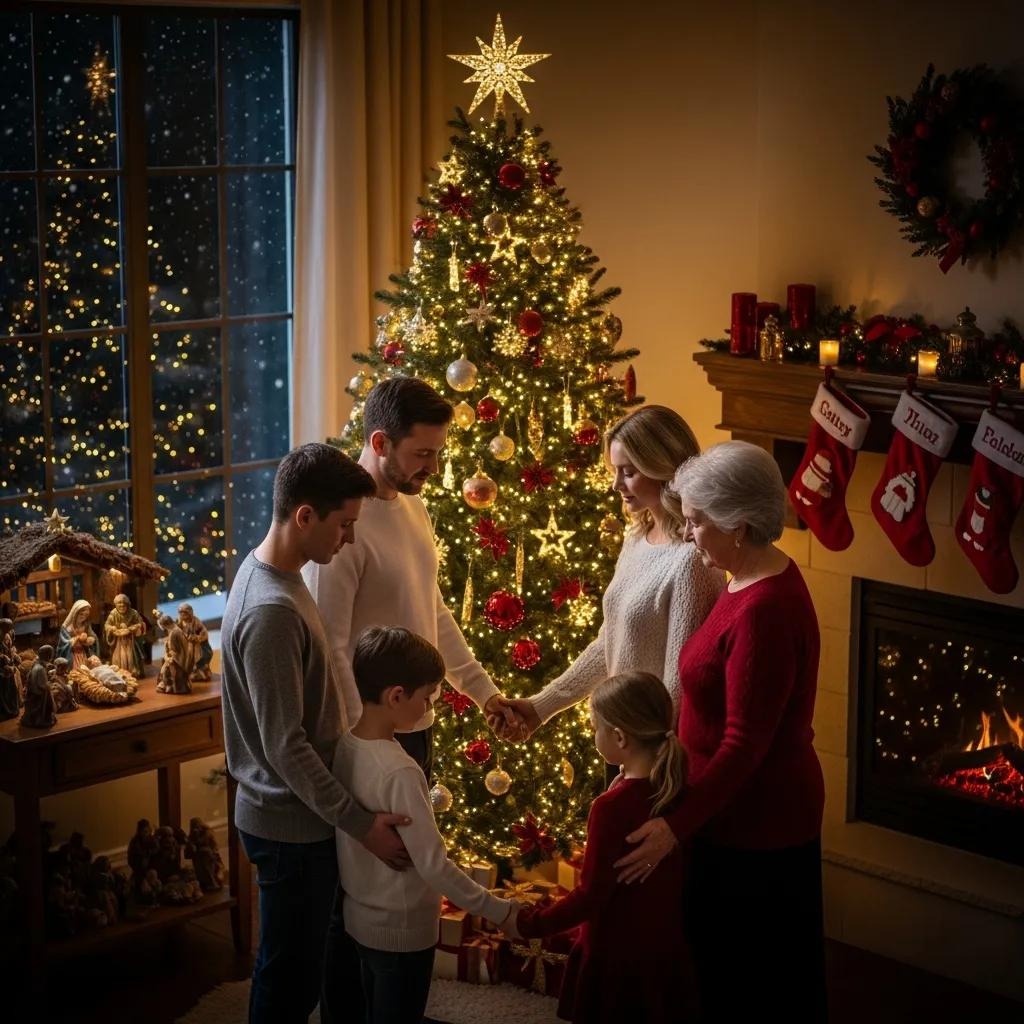
Praying as a family during Christmas combines structure and flexibility to create inclusive rituals that invite all ages to participate in remembering the Nativity and sharing gratitude. A simple family devotion framework includes a welcome, a short scripture reading (Nativity passage), a brief reflection, a responsive prayer, and a closing blessing—each element is brief but purposeful so gatherings remain warm and unrushed. Families can adapt language and length for children, using responsive lines or short call-and-response prayers that let younger members speak.
Indeed, the significance of Christmas celebrations for families, especially those with children, is a well-recognized aspect of family rituals, often requiring considerable planning and attention.
Follow these steps for a short family devotion:
- Welcome and Centering: Light a candle, offer one sentence welcome to create focus.
- Scripture Reading: Read a short Nativity passage (one paragraph) aloud.
- Reflection: Share a one-sentence prompt and invite one family member to respond.
- Prayer and Blessing: Offer a short communal prayer and close with a blessing.
These steps create a reproducible ritual that families can use nightly or on special occasions, building memory and shared spiritual practice that encourages ongoing devotion beyond Christmas. After establishing a family pattern, consider a simple devotional app that supports shared tracking and community prayer for encouragement.
What Are Meaningful Christmas Prayers for Family Gatherings?
Meaningful Christmas prayers for family gatherings should be short, inclusive, and adaptable, covering moments like mealtime, gift opening, and family reflection while inviting different ages to participate. Sample prayers include a simple mealtime blessing that thanks God for provision, a brief prayer before opening gifts that centers gratitude rather than possessions, and a bedtime prayer that asks for protection and peace. For children, use call-and-response lines such as “Glory to God” — “and peace on earth” to make participation lively and memorable. These adaptable prayers help families mark specific moments with intention and ensure that spiritual focus remains central to celebratory activities.
How Can Family Prayer Foster Togetherness and Faith?
Family prayer fosters togetherness and faith by creating shared rituals that produce emotional bonding, mutual accountability, and lasting memories tied to spiritual formation. Regular short devotions—repeated prayers, responsive lines, or a nightly scripture—build a common language of faith that children and adults remember and carry into adulthood. Practical practices include rotating leadership so different family members lead prayer, incorporating simple songs or liturgical lines, and pairing prayer with a shared act of service to extend faith into action. These practices form micro-habits of devotion that strengthen familial bonds and encourage ongoing spiritual growth, naturally leading families to consider communal supports such as devotional communities and tracking tools.
What Are Traditional Catholic Christmas Prayers and Novenas?
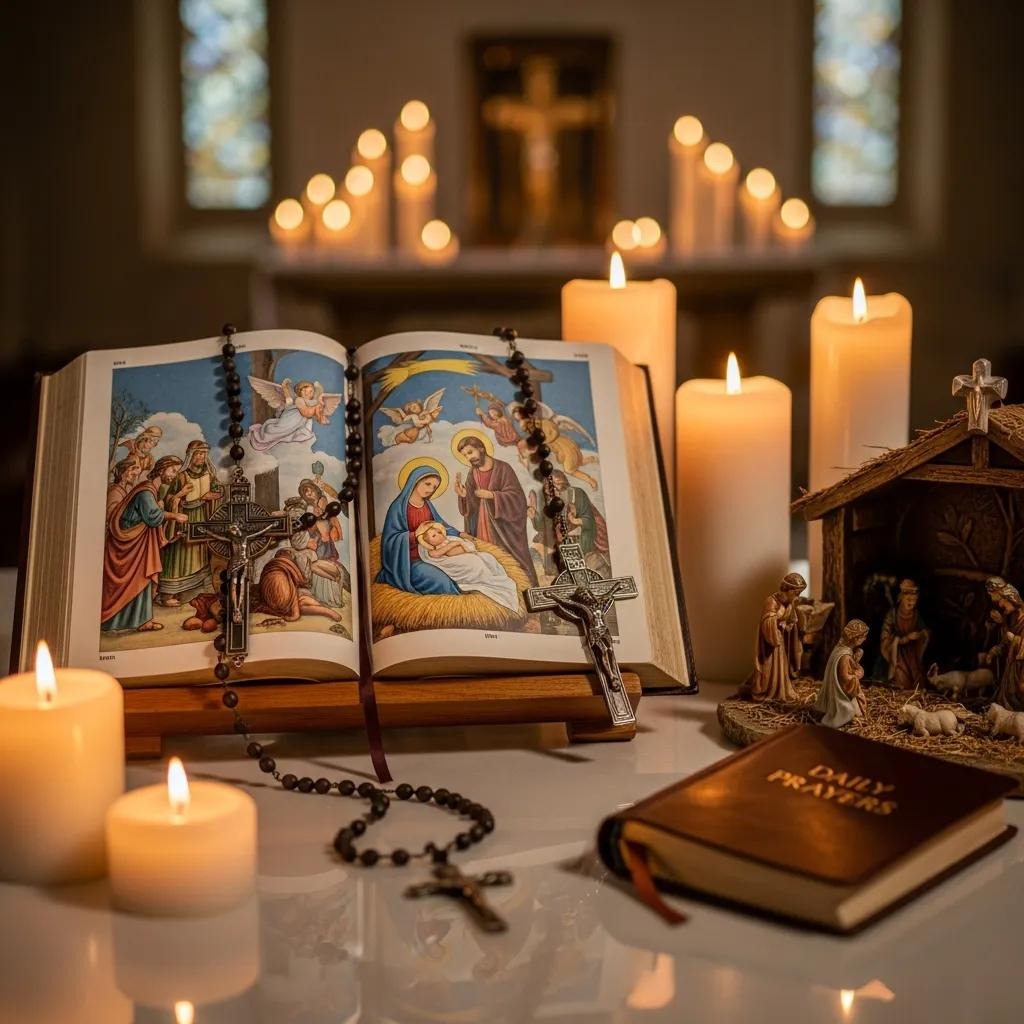
Traditional Catholic Christmas prayers and novenas are rooted in liturgical and devotional practices that prepare hearts for the Nativity, often using structured texts like the O Antiphons, the Angelus, and nine-day novenas that emphasize anticipation and intercession.
A novena is a dedicated nine-day prayer sequence focused on a particular intention and often used in Advent to prepare spiritually for Christmas; its mechanism is sustained, focused intercession that shapes hope and expectation.
Catholics often use set prayers, short scripture passages, and liturgical antiphons to enter the season’s mystery, employing ritual timing and repetition as devotional scaffolding. The next table compares several traditional prayers, their origins, and practical steps for private or communal use to help readers adopt these devotions.
Intro: The following table compares selected Catholic prayers and novenas, giving origins and simple steps so readers can choose a devotion that fits their rhythm during Advent and Christmas.
| Prayer/Novenas Name | Tradition/Origin | How to pray (steps) / When to use |
|---|---|---|
| O Antiphons | Western liturgy, Advent | Pray nightly before Magnificat during late Advent; reflect on each title of Christ |
| Angelus | Medieval devotion | Recite morning, noon, and evening with short verses and Hail Mary; use for daily centering |
| Christmas Novena | Popular devotion | Pray a specific novena text for 9 days before Christmas; focus each day on a theme |
This comparison shows how ritual texts and novenas offer structured paths into Advent contemplation, and the steps provided make it easier to begin these practices in private devotions or with family groups.
Which Catholic Prayers Celebrate the Nativity and Advent?
Catholic prayers that celebrate the Nativity and Advent include the O Antiphons, the Angelus, and canticles used in evening prayer that highlight the coming of Christ and the themes of hope and longing. The O Antiphons are sung or recited in the days leading up to Christmas, each addressing Christ with a different title—an exercise in meditative naming that deepens expectation. The Angelus commemorates the Incarnation with short versicles and collects, suitable for quick devotional pauses throughout the day. For private devotion, using brief excerpts from these texts with a one-sentence reflection makes them approachable and spiritually enriching, especially for households seeking a liturgical rhythm in the home.
How to Participate in a Christmas Novena Using FaithTime App?
To participate in a Christmas novena using FaithTime App, prepare by selecting a nine-day devotion within the app, schedule daily reminders, and commit to a brief scripture reading and prayer prompt each day that the app provides. Faithtime.ai’s devotion tracking and community prayer intentions can help users maintain commitment by sending gentle reminders and allowing shared intentions for mutual encouragement. Begin by choosing a novena theme, set a daily micro-goal (for example, two minutes of reading and one prayer), and use the app’s community features to submit an intention you want others to pray for. Using a digital companion like Faithtime.ai enhances accountability and makes communal novena participation feasible for busy individuals and families.
How to Use the FaithTime App to Enhance Your Christmas Prayer Experience?
Faithtime.ai can enrich your Christmas prayer life by supplying short daily devotions, devotion tracking to build consistency, an animated “Little Lamb” for personalized spiritual growth, AI-powered Bible Chat for scripture context, and community prayer intentions that expand your focus beyond immediate circles. These features support habit formation through micro-goals and streaks, encourage empathy by sharing community needs, and provide quick contextual help for difficult passages during Advent reflections. Practically, set a daily devotion reminder, use the Little Lamb as a visual motivator for family participation, consult Bible Chat for brief verse summaries, and join community intentions to pray for broader concerns such as refugees or local families in need. Together these tools make it easier to sustain the discipline of prayer, especially when holiday schedules threaten consistency.
How Does Devotion Tracking Support Your Christmas Spiritual Growth?
Devotion tracking supports Christmas spiritual growth by turning intentions into measurable habits, using small daily targets—like a one-minute prayer or a single verse—to create momentum and spiritual formation over weeks. Behavior-change mechanics such as streaks and micro-goals reduce friction for busy users, helping them prioritize spiritual rhythms amid holiday obligations. For example, set goals to read a Nativity verse each morning, say a one-line prayer at mealtimes, and log each session to reinforce the habit. These small, consistent practices yield long-term spiritual benefits by shifting focus from occasional religious activity to a sustained devotional life that deepens faith beyond the season.How Can Community Prayer Intentions Enrich Your Holiday Faith?
Community prayer intentions enrich holiday faith by widening the scope of intercession, fostering empathy, and providing mutual encouragement through shared needs and responses. Praying with a community surfaces concerns you may not have considered—such as displaced families or local hardship—and creates spiritual solidarity that counters isolation. Practical tips include submitting a concise intention that others can easily pray for, joining a themed communal devotion (peace, reconciliation, hope), and using anonymity options to protect privacy while still inviting support. Shared intentions cultivate a collective prayer life that complements private devotions and strengthens the church’s witness of care during Christmas.
Which Bible Verses Are Best for Christmas Prayer Reflection?
Bible verses best for Christmas prayer reflection are passages that highlight the incarnation, the promise of a Savior, and the themes of peace, joy, and hope; key texts include Luke 2, Isaiah 9:6, John 1:14, and Matthew 1–2. These passages function as hypernyms of Nativity literature—broad scriptural anchors—while shorter excerpts and related hymnic lines serve as hyponyms useful for responsive prayers and family readings. Using specific thematic pairings helps direct prayer: Isaiah 9:6 for hope and promise, Luke 2 for wonder and worship, and John 1 for theological reflection on the Word made flesh. The table below maps selected passages to themes and reflection prompts to support focused devotional practice.
Intro: The table below lists scripture passages, their references, a thematic takeaway, and a short reflection prompt to guide Christmas prayer and meditation.
| Scripture Passage | Book & Reference | Thematic takeaway / Short reflection prompt |
|---|---|---|
| Birth narrative | Luke 2:1-20 | Worship and wonder — Where do I see God’s humility today? |
| Promise of a child | Isaiah 9:6 | Hope and identity — How does this promise shape my trust? |
| Word made flesh | John 1:14 | Incarnation mystery — How has God’s presence changed my life? |
| Joseph’s faith | Matthew 1:18-25 | Obedience and protection — Where is faithful courage needed now? |
What Scripture Passages Highlight Jesus Christ’s Birth and Message?
Primary nativity passages such as Luke 2 and Matthew 1–2 narrate the circumstances of Jesus’ birth and highlight themes of announcement, protection, and divine intervention, offering clear material for prayer and reflection. Each passage provides a distinct devotional angle: Luke 2 emphasizes praise and shepherdly witness, Matthew recounts fulfillment of prophecy and providential care, and John 1 reframes the Incarnation in cosmic, theological terms for deeper contemplative prayer. Short prayer prompts tied to each passage help readers move from reading to responding—for example, after Luke 2 ask, “How does this message invite my praise today?”—which makes scripture reading a springboard for meaningful prayer.
How to Understand the Spiritual Meaning of Christmas Bible Verses?
To understand the spiritual meaning of Christmas Bible verses, read each passage devotionally by noting context, identifying the key theme, and applying a one-sentence reflection to current life situations such as loneliness, gratitude, or a call to justice. Hermeneutical cues—who speaks, to whom, and why—help you translate ancient texts into present prayer: recognize authorship and audience, then ask how the verse shapesa prayer response. Apply three practical examples: use Isaiah 9:6 for hope in despair, Luke 2 for communal praise amidst family stress, and John 1 for worship when theology deepens wonder. For quick context or deeper questions during this process, consult an AI scripture assistant or Bible Chat to clarify difficult phrases and enrich your devotional response.
If you would like more ideas for praying through the season, you can explore a short Christmas devotion series that offers daily reflections on Christ’s birth for you or your family. You can also download FaithTime app and use its gentle reminders and Christmas devotions to help you stay prayerful throughout Advent and on Christmas Day. You can also meditate on Christmas Bible verses that highlight hope, light, and salvation, using them as simple readings or closing blessings in your own Christmas gatherings